GMKtec EVO-X2 (Strix Halo 128GB) vs Particle Tachyon (5G 12-TOPS SBC) vs HP Z2 Mini G1a Comparison: $1,799 96GB VRAM Mini Workstation vs $149 5G Field AI Node
A technical silicon and edge deployment comparison of the GMKtec EVO-X2 ($1,799, 16-core AMD Ryzen AI Max+ 395 mini workstation with 128GB LPDDR5X-8000 unified memory, up to 96GB UMA VRAM allocation, and 140W dual-fan vapor-chamber cooling), Particle Tachyon ($149, Raspberry Pi-sized credit-card Ubuntu SBC with Qualcomm QCM6490, 12-TOPS Hexagon 770 NPU, and integrated global 5G Sub-6GHz EtherSIM+), and HP Z2 Mini G1a ($2,299).
Executive Summary: $1,799 128GB Strix Halo Desktop Nodes vs $149 5G Cellular Autonomous Field SBCs
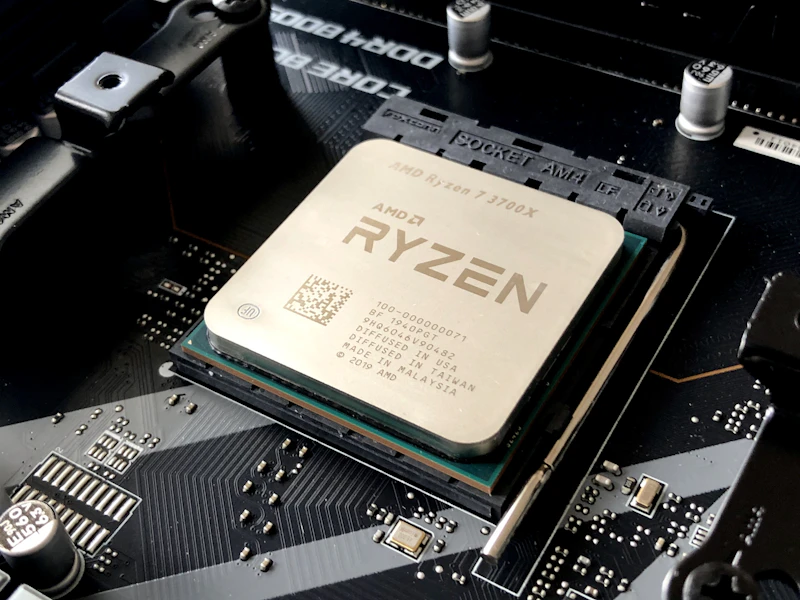
Methodology & Source Disclosure: This article is a comparative silicon and edge-compute architecture analysis compiled from publicly released manufacturer datasheets and hardware documentation published by GMKtec, Particle, Qualcomm, HP, and Framework. All memory bandwidth, TOPS ratings, power envelopes, and connectivity metrics reflect vendor-published specifications. Representative illustration via Unsplash.
Deploying distributed AI infrastructure in late 2026 requires matching compute topology to physical power and backhaul constraints: at the on-premise desk and home-lab tier, the $1,799 GMKtec EVO-X2 brings AMD's flagship 16-core Ryzen AI Max+ 395 ("Strix Halo", 40-CU Radeon 8060S + 50-TOPS XDNA 2 NPU, 126 total TOPS) and 128GB of 256-bit LPDDR5X-8000 unified memory (up to 96GB dedicated UMA VRAM) below the $1,800 barrier—running 70B Q8 and 120B Q4 LLMs locally inside a 140W vapor-chamber aluminum mini PC. At the untethered outdoor edge—where autonomous agricultural rovers, solar sentry cameras, and drone base stations operate miles from Wi-Fi—the $149 Particle Tachyon (52g, 85×56mm Raspberry Pi footprint) integrates an octa-core Qualcomm Dragonwing QCM6490 SoC, a 12-TOPS Hexagon 770 NPU, 4GB RAM, 64GB UFS flash, and a global 5G Sub-6GHz cellular modem (with built-in EtherSIM+) onto a single credit-card Linux board.
1. 128GB Strix Halo Mini Workstations & 5G Field Edge AI SBC Specification Matrix
The matrix below compares official manufacturer specifications for the GMKtec EVO-X2 ($1,799), Particle Tachyon 5G SBC ($149), HP Z2 Mini G1a ($2,299), and Framework Desktop 128GB ($1,999).
| Published Silicon & System Specification | GMKtec EVO-X2 128GB ($1,799) | Particle Tachyon 5G SBC ($149) | HP Z2 Mini G1a 128GB ($2,299) | Framework Desktop 128GB ($1,999) |
|---|---|---|---|---|
| Form Factor & Target Tier | Compact CNC Desktop Mini Workstation | 85×56mm Credit-Card 5G Field SBC (52g) | 2.9L Enterprise Desk / 4U Rack Node | 4.5L Modular Mini-ITX Desktop |
| Core Compute Silicon | AMD Ryzen AI Max+ 395 (16C Zen 5, x86) | Qualcomm QCM6490 (8C Kryo 670, ARM64) | AMD Ryzen AI Max+ PRO 395 (x86) | AMD Ryzen AI Max+ 395 (x86) |
| GPU & NPU Accelerator Stack | 40-CU Radeon 8060S + 50-TOPS XDNA 2 | Adreno 643 GPU + 12-TOPS Hexagon 770 | 40-CU Radeon 8060S + 50-TOPS XDNA 2 | 40-CU Radeon 8060S + 50-TOPS XDNA 2 |
| Published Total AI Compute | Up to 126 Total System TOPS | 12 INT8 TOPS (On-Die Hexagon DSP) | Up to 126 Total System TOPS | Up to 126 Total System TOPS |
| Memory & VRAM Capacity | 128GB LPDDR5X-8000 (Up to 96GB VRAM) | 4GB LPDDR4X RAM + 64GB UFS Flash | 128GB LPDDR5X-8533 (Up to 96GB VRAM) | 128GB LPDDR5X-8000 (Up to 96GB VRAM) |
| Memory Bus & Bandwidth | 256-Bit Quad-Channel (~256 GB/s) | Low-Power Mobile Bus + PCIe Gen3 x2 | 256-Bit Quad-Channel (~256 GB/s) | 256-Bit Quad-Channel (~256 GB/s) |
| Power & Thermal Envelope | 54W / 85W / 140W Dual-Fan Vapor Chamber | 5V USB-C PD or Li-Ion Battery PMIC | Internal 300W PSU (45W–120W+ APU) | Internal 400W SFX PSU (120W+ APU) |
| Networking & Telemetry Backhaul | 2.5GbE + Wi-Fi 7 + 2× 40Gbps USB4 | Global 5G Sub-6 (2.5Gbps EtherSIM+) + Wi-Fi 6E | 10GbE + Wi-Fi 7 + 2× Thunderbolt 4 | 5GbE + Wi-Fi 7 + 2× 40Gbps USB4 |
2. GMKtec EVO-X2 Architecture: Unlocking 140W Strix Halo & 96GB UMA VRAM for $1,799
When running 70-billion-parameter LLMs (Llama-3.3-70B, DeepSeek-R1-Distill-Llama-70B, Qwen2.5-72B) locally, token generation speed is governed by memory bandwidth (~256 GB/s across Strix Halo's 256-bit bus), while prompt prefill speed scales with sustained GPU/NPU thermal wattage.
┌──────────────────────────────────────────────────────────────────────────────┐
│     GMKTEC EVO-X2 ($1,799 128GB STRIX HALO) vs PARTICLE TACHYON ($149 5G)    │
│                                                                              │
│  [GMKTEC EVO-X2: AMD Ryzen AI Max+ 395 + 128GB LPDDR5X-8000 + 2TB NVMe]      │
│     │  ──► Locks Up to 96GB Dedicated UMA VRAM for 40-CU Radeon 8060S GPU    │
│     │  ──► 3-Mode Thermal Switch: 54W Silent / 85W Balanced / 140W Max Boost │
│     ▼  ──► Runs 70B Q8 & 120B Q4 Local LLMs via ROCm / Vulkan / LM Studio    │
│  Design Focus: Highest Price-Performance 128GB Local LLM & Developer Mini PC │
│                                                                              │
│  [PARTICLE TACHYON: Credit-Card Qualcomm QCM6490 + 12-TOPS NPU + Global 5G]  │
│     │  ──► 8-Core Kryo 670 + 12-TOPS Hexagon 770 NPU + 64GB UFS Onboard      │
│     │  ──► Integrated 5G Sub-6GHz Modem (2.5Gbps) w/ Reprogrammable EtherSIM+│
│     ▼  ──► Onboard Li-Ion Battery Charger + Dual MIPI-CSI + 40-Pin RPi GPIO  │
│  Design Focus: Untethered Outdoor Robotics, Drones & Remote Vision Sentries  │
└──────────────────────────────────────────────────────────────────────────────┘
Three Engineering Highlights of the GMKtec EVO-X2 ($1,799):
- 96GB Dedicated UMA VRAM + 2TB NVMe SSD Included Under $1,800: By pairing the 16-core / 32-thread AMD Ryzen AI Max+ 395 (up to 5.1GHz) with 128GB of soldered 256-bit LPDDR5X-8000 memory and a pre-installed 2TB PCIe 4.0 M.2 NVMe SSD, the EVO-X2 undercuts enterprise workstations (
HP Z2 Mini G1aat $2,299) by $500 while exposing the exact same 96GB Variable Graphics Memory (UMA VRAM) pool to the 40-CU Radeon 8060S GPU. - 140W Peak Dual-Turbine Vapor-Chamber Cooling: To prevent thermal throttling during long multi-thousand-token prompt prefills or local LoRA fine-tuning, GMKtec engineered a full-coverage copper vapor chamber with dual turbine blowers and three hardware-selectable power modes: 54W Quiet Mode, 85W Balanced Mode, and 140W Performance Mode.
- Quad-Display & Dual-USB4 Expansion: Includes two 40Gbps USB4 ports, HDMI 2.1, DisplayPort 2.1, 2.5GbE Ethernet, Wi-Fi 7, and an SD 4.0 card reader for local multimodal creator workflows.
3. Particle Tachyon Architecture: Why Field Robotics Needs Integrated 5G + 12 TOPS in an 85×56mm Footprint
Building a remote outdoor computer-vision node or field robot on a standard Raspberry Pi 5 typically requires bolting on a separate M.2 AI NPU HAT, an external USB cellular modem, a SIM card tray, an external GPS module, and a separate Li-Ion battery management board—resulting in a fragile, power-hungry stack of cables and adapters.
How Particle Tachyon ($149) Consolidates the Field Edge Stack:
- Smartphone-Class Qualcomm QCM6490 + 12-TOPS Hexagon 770 NPU: Utilizing the industrial long-lifecycle Qualcomm Dragonwing QCM6490 (1× Cortex-A78 @ 2.7GHz, 3× Cortex-A78 @ 2.4GHz, 4× Cortex-A55 @ 1.9GHz), Tachyon delivers 12 INT8 TOPS of on-die AI acceleration, 4GB LPDDR4X RAM, and 64GB of high-endurance UFS flash (far faster and more reliable than microSD cards) on a single 85×56mm (
52g) PCB. - Built-In Global 5G Sub-6GHz Modem, EtherSIM+ & Dual-Frequency GNSS: Tachyon integrates a 2.5Gbps 5G Sub-6GHz cellular modem (with LTE fallback), custom multi-band antenna, dual-frequency GPS, Wi-Fi 6E, and Particle's reprogrammable EtherSIM+ (supporting 180+ countries) plus out-of-band remote fleet console management.
- Native Li-Ion PMIC & Raspberry Pi 40-Pin Compatibility: Developers can plug a single-cell Li-Ion battery directly into Tachyon's onboard charger/fuel-gauge header, connect two 4-lane MIPI-CSI cameras (up to 64MP ISP), attach existing 40-pin Raspberry Pi HATs, and deploy containerized vision/audio models on Ubuntu 24.04 Linux.
4. Official Sources, Datasheets & Edge Compute Selection Guide
Primary Manufacturer Sources & Documentation:
- GMKtec — EVO-X2 (AMD Ryzen AI Max+ 395 128GB) Official Product Page: gmktec.com
- Particle — Tachyon 5G + 12-TOPS Qualcomm QCM6490 SBC Specifications: particle.io/tachyon
- HP — Z2 Mini G1a Workstation (Ryzen AI Max+ PRO 395): hp.com/us-en/workstations/z2-mini-a.html
- Framework — Framework Desktop (Ryzen AI Max+ 395): frame.work
Platform Selection Summary:
- Select the GMKtec EVO-X2 128GB ($1,799) if you want the best price-to-performance 128GB Strix Halo mini workstation (up to 96GB UMA VRAM + 140W vapor-chamber cooling) for running local 70B–120B LLMs at your desk.
- Select the HP Z2 Mini G1a 128GB ($2,299) if you need an internal 300W PSU, 10GbE networking, and 5-nodes-per-4U enterprise rack density.
- Select the Particle Tachyon ($149) if you are deploying outdoor autonomous robots, drones, or remote vision cameras that need 12 TOPS of edge AI, 64GB UFS flash, Li-Ion battery management, and global 5G cellular connectivity in a Raspberry Pi footprint.
🔗 Related AI Hardware Benchmarked in This Report
GMKtec EVO-X2 Mini AI Workstation (Ryzen AI Max+ 395 128GB Unified) →
High-value 128GB unified-memory mini AI workstation powered by the 16-core AMD Ryzen AI Max+ 395 (40-CU Radeon 8060S + 50-TOPS XDNA 2 NPU, 126 total TOPS), supporting up to 96GB UMA VRAM allocation at a 140W peak thermal envelope.
Particle Tachyon 5G + 12-TOPS Qualcomm QCM6490 Edge AI SBC →
Raspberry Pi-sized credit-card Linux single-board computer combining an octa-core Qualcomm Dragonwing QCM6490 SoC and 12-TOPS Hexagon 770 NPU with built-in global 5G Sub-6GHz cellular connectivity (EtherSIM+), Wi-Fi 6E, 4GB RAM, and 64GB UFS flash.
HP Z2 Mini G1a Workstation (Ryzen AI Max+ PRO 395 128GB Unified) →
2.9-liter enterprise mini workstation powered by the 16-core AMD Ryzen AI Max+ PRO 395 (Zen 5 + 40-CU Radeon 8060S + 50-TOPS XDNA 2 NPU) with 128GB 8533 MT/s LPDDR5X unified memory and up to 96GB dedicated VRAM allocation for local 70B+ LLMs.
Framework Desktop (Ryzen AI Max+ 395 128GB) →
4.5-liter modular Mini-ITX workstation powered by AMD's 16-core Ryzen AI Max+ 395 ('Strix Halo') APU with a 40-CU Radeon 8060S GPU and 128GB unified LPDDR5X-8000 memory for local 70B–120B LLM execution.
📚 Related Deep-Dive Teardowns & Benchmarks
Browse All 118 Articles →HP Z2 Mini G1a (Strix Halo 128GB) vs ASUS Ascent GX10 (GB10) vs NVIDIA DGX Spark Comparison: 96GB UMA VRAM vs 1-PFLOP FP4
A technical architecture and specification comparison of the HP Z2 Mini G1a ($2,299, 2.9L AMD Ryzen AI Max+ PRO 395 workstation with 128GB LPDDR5X-8533 and 96GB allocatable UMA VRAM), ASUS Ascent GX10 ($3,499, NVIDIA GB10 Grace Blackwell Superchip with 1,000 FP4 TOPS, 128GB unified RAM, and 200GbE ConnectX-7), Framework Desktop ($1,999), and NVIDIA DGX Spark ($3,999).
MemryX MX3 vs Kinara Ara-2 (NXP) vs Axelera Metis M.2 Comparison: DRAM-Free At-Memory Dataflow vs 16GB 40-TOPS Edge GenAI NPU
A technical silicon architecture comparison of the MemryX MX3 M.2 2280 ($149, 4-chip 24-TFLOPS BF16/INT8 At-Memory Dataflow accelerator requiring zero external DRAM at ~8W), Kinara Ara-2 / NXP Ara-240 M.2 ($188, 40-TOPS polymorphic Edge GenAI NPU with 16GB LPDDR4X for local LLMs and VLMs), and Axelera Metis M.2 Max ($189).
Axelera Metis M.2 Max vs SiMa.ai Modalix vs DEEPX DX-M1 Comparison: 214-TOPS D-IMC vs 6nm Multimodal Physical AI SoM
A technical architecture and specification comparison of the Axelera Metis M.2 Max ($189, 214 INT8 TOPS Digital In-Memory Computing AIPU at 15 TOPS/W), SiMa.ai Modalix DevKit 3.0 ($999, TSMC 6nm 50-TOPS standalone Physical AI SoM with 4x MIPI CSI-2), DEEPX DX-M1 ($139, 25 TOPS at 3.2W), and Hailo-10H ($130).
DEEPX DX-M1 (25 TOPS) vs Hailo-10H vs Milk-V Megrez RISC-V Benchmark: Sub-5W M.2 NPU & SiFive P550 Edge AI Tested
RECIWO Labs benchmarked the $139 DEEPX DX-M1 5nm M.2 NPU (25 TOPS at 3.2W, 4GB LPDDR5, IQ8 FP16-equivalent quantization) and the $199 Milk-V Megrez Mini-ITX RISC-V AI motherboard (ESWIN EIC7700X quad-core SiFive P550 + 19.95 TOPS NPU + 32GB LPDDR5) against the Raspberry Pi AI HAT+ 2 (Hailo-10H 40 TOPS).