1X NEO vs Fourier GR-2 vs Unitree G1 Architecture Comparison: 30kg Compliant Tendon Drive vs 380 N·m FSA 2.0 Actuators
A technical specification and actuation architecture comparison of the 1X NEO (30kg compliant tendon-driven domestic humanoid), Fourier GR-2 (63kg, 53-DoF research humanoid with 380 N·m FSA 2.0 dual-encoder actuators and 12-DoF tactile hands), and Unitree G1 ($16,000), compiled from official manufacturer datasheets and public engineering disclosures.
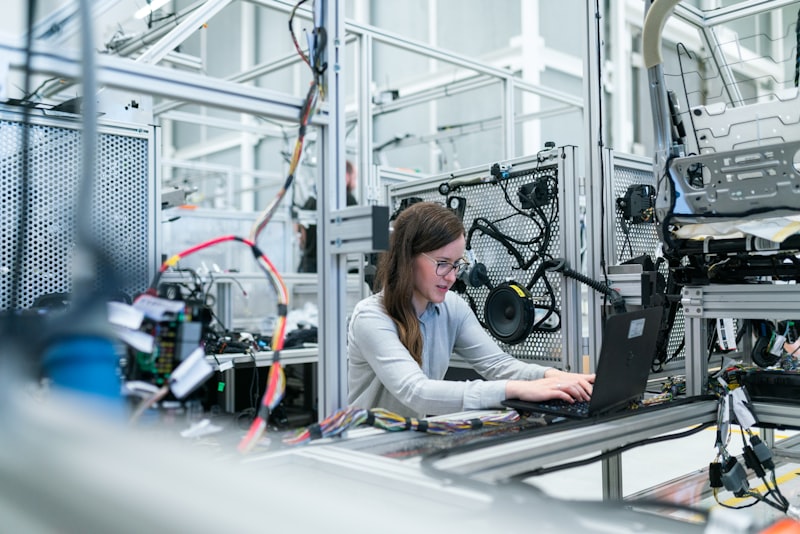
Executive Summary: Tendon Compliance vs Rotary Actuator Authority
Methodology & Source Disclosure: This article is a comparative engineering analysis compiled from publicly released manufacturer specifications, technical whitepapers, and developer SDK documentation published by 1X Technologies, Fourier Intelligence, Unitree Robotics, and AgiBot. All metrics in the tables below reflect vendor-published datasheets and kinematic transmission characteristics rather than in-house physical impact or acoustic bench tests. Representative illustration via Unsplash.
Comparing the official architecture disclosures of 2026 humanoid platforms highlights a clear divergence between domestic tendon-driven compliance and rigid rotary research actuators: the 1X NEO (165–168cm, 30.0kg) prioritizes low distal limb inertia, backdrivable tendon transmission, and a soft polymer knit exterior for unstructured home environments. Conversely, for academic laboratories, industrial manipulation cells, and high-payload Sim-to-Real research, the Fourier GR-2 (175cm, 63.0kg) prioritizes high joint torque and kinematic repeatability—delivering up to 380 N·m peak hip torque via second-generation FSA 2.0 dual-encoder smart actuators and 12-DoF dexterous hands with 6 integrated tactile pressure arrays.
1. Full-Size & Mid-Size Humanoid Specification Matrix (Official Datasheets)
The matrix below compares published hardware specifications for the domestic-focused 1X NEO, the full-size research flagship Fourier GR-2, the compact developer platform Unitree G1 EDU ($16,000), and the AgiBot Lingxi X2.
| Published Specification & Architecture | 1X NEO (1X Technologies) | Fourier GR-2 (Fourier) | Unitree G1 EDU ($16,000) | AgiBot Lingxi X2 |
|---|---|---|---|---|
| Standing Height & Total Mass | ~165–168 cm / 30.0 kg (Ultralight Full-Size) | 175 cm / 63.0 kg | 132 cm / 35.0 kg | 130 cm / 33.8 kg |
| Total Degrees of Freedom (DoF) | High-DoF Body + Multi-DoF Tendon Hands | 53 DoF (Inc. Dual 12-DoF Hands) | 23–43 DoF (3-Finger Dex3-1) | 28–34 DoF (OmniPicker / Tactile) |
| Primary Joint Actuation Topology | Remote Brushless + Synthetic Tendon Drive | FSA 2.0 Cycloidal/Harmonic + Dual Encoder | Quasi-Direct Drive (QDD Planetary) | QDD Planetary + Cross-Roller |
| Published Peak Joint Torque | Compliant Low-Ratio Tendon Tension | Up to 380 N·m (FSA 2.0 Hip Actuator) | 120 N·m (PMSM Knee/Hip) | 150 N·m |
| Published Payload Capacity | Up to 20–25 kg Carry / ~8 kg Lift | 3.0 kg per 7-DoF Single Arm (6.0 kg Dual) | 3.0 kg per Arm | 3.5 kg per Arm |
| Exterior Chassis & Safety Design | Soft 3D-Lattice Polymer + Knit Bodysuit | Rigid Machined Aluminum Alloy Shell | Rigid PC/ABS & Alloy Shell | Rigid Composite & Alloy Shell |
| Acoustic & Compliance Profile | Gearless Distal Tendons (Low Mechanical Noise) | High-Ratio Rotary Gearboxes | High-Speed QDD Planetary | QDD Planetary |
| Battery Architecture & Runtime | Internal Pack (~2–4 hrs Target Household Use) | Detachable 2× Capacity Pack (~2.0 hrs) | 9,000mAh Quick-Swap (~2.0 hrs) | Detachable Pack (~2.0 hrs) |
2. Mechanical Architecture Analysis: 1X NEO Tendon Compliance vs Fourier GR-2 FSA 2.0 Gearboxes
From a classical mechanics perspective, the fundamental divide in humanoid actuation comes down to reflected rotor inertia ($I_{ref} = I_{rotor} \times N^2$, where $N$ is the gear reduction ratio).
┌──────────────────────────────────────────────────────────────────────────────┐
│     1X NEO (TENDON-DRIVEN BIO-MIMETIC) vs FOURIER GR-2 (FSA 2.0 ROTARY)      │
│                                                                              │
│  [1X NEO: Remote Brushless Motors Housed in Torso / Proximal Limbs]          │
│     │  ──► High-Tensile Synthetic Tendons + Series Elastic Compliance        │
│     │  ──► Lower Distal Joint Mass & Low Reflected Inertia                   │
│     ▼  ──► Soft Polymer Cushioning + Machine-Washable Knit Exterior          │
│  Design Focus: 30kg Total Mass | Passive Human Contact Safety | Quiet Home   │
│                                                                              │
│  [FOURIER GR-2: Coaxial FSA 2.0 Smart Actuators at Every Joint]              │
│     │  ──► Up to 380 N·m Peak Torque + Dual Magnetic/Inductive Encoders      │
│     │  ──► 7-DoF Serial Arms + 12-DoF Hands w/ 6× Tactile Pressure Arrays    │
│     ▼  ──► High-Bandwidth Real-Time Bus & Open Sim-to-Real SDK               │
│  Design Focus: 63kg Rigid Authority | Isaac Lab / ROS 2 | Lab & Rehab Tasks  │
└──────────────────────────────────────────────────────────────────────────────┘
Why 1X NEO Weighs Only 30 kg at Full Human Stature:
- Remote Tendon Routing Reduces Distal Limb Inertia: In conventional rotary humanoids, placing heavy electric motors and harmonic/planetary reducers directly inside the wrists, elbows, knees, and ankles increases distal pendulum mass, which in turn demands heavier hip and shoulder actuators. According to 1X Technologies' engineering disclosures, NEO relocates primary actuator mass proximally into the torso and upper limbs, transmitting force through low-friction synthetic tendons. This structural choice enables a full-height humanoid to weigh 30.0 kg—roughly half the mass of rigid full-size peers—while supporting up to 20–25 kg in bimanual carrying tasks.
- Passive Backdrivability & Soft Exterior Shell: By avoiding high-ratio metallic gear trains at the extremities and wrapping the chassis in a soft, compressible polymer lattice beneath a knit suit, tendon-driven architectures reduce peak contact impulse during accidental human-robot contact (a critical requirement under ISO/TS 15066 collaborative robotics guidelines) and eliminate high-frequency metallic gear whine in quiet indoor settings.
- End-to-End VLA + Scheduled Remote Teleoperation Assist: 1X pairs NEO's compliant hardware with its onboard vision-language-action (Redwood VLA) foundation model trained on first-person manipulation trajectories, supplemented by a WebRTC human-in-the-loop teleoperation fallback for novel edge cases.
3. Fourier GR-2 Architecture: 380 N·m FSA 2.0 Actuators & 12-DoF Tactile Array Hands
Where 1X NEO optimizes for lightweight domestic coexistence, the Fourier GR-2 is engineered for university AI labs, industrial kitting, and physical rehabilitation—where repeatable joint kinematics and open low-level SDK access are paramount.
| Manipulation & SDK Specification (Published) | 1X NEO (Tendon Hand) | Fourier GR-2 (12-DoF Tactile Hand) | Unitree G1 (Dex3-1 3-Finger) |
|---|---|---|---|
| Hand Actuation Topology | Multi-DoF Tendon-Driven Fingers | 12-DoF Linkage (6 Active DoF/Hand) | 7-DoF Force-Position Hybrid |
| Integrated Tactile Sensing | Tendon Tension & Motor Current Sensing | 6× Tactile Pressure Sensor Arrays | Optional 94-Taxel Force Array |
| Arm Degrees of Freedom | Compliant Anthropomorphic Dual Arms | 7-DoF Serial Arms (3.0 kg Payload/Arm) | 5-to-7 DoF Arms (3.0 kg Payload) |
| Joint Position Feedback | Motor + Tendon Tension Encoders | Dual Encoders (Rotor + Output Shaft) | Dual Absolute Joint Encoders |
| Open Developer SDK & Sim Support | Partner / Consumer API Focus | URDF + NVIDIA Isaac Lab + MuJoCo + ROS 2 | Full URDF/MJCF + ROS 2 + Isaac Lab |
Three Documented Engineering Upgrades on the Fourier GR-2:
- Dual-Encoder FSA 2.0 Smart Actuators (Up to 380 N·m Peak): In Fourier's published GR-2 specification, the proprietary FSA 2.0 (Fourier Smart Actuator) family integrates both a rotor-side magnetic encoder and an output-side absolute inductive encoder. This dual-encoder loop compensates for reducer backlash and transmission elasticity while delivering up to 380 N·m peak torque at the hip pitch joint.
- 6× Multi-Taxel Tactile Arrays per 12-DoF Hand: Each of GR-2's 12-DoF dexterous hands integrates six array-type tactile pressure sensors across the fingertips and palm, providing real-time normal force feedback for closed-loop grasping of deformable or fragile objects.
- Serial-Parallel Leg Kinematics + Detachable Battery: By relocating ankle actuators higher on the shin via parallel linkage rods and flattening internal cable harnesses, Fourier reduced lower-limb inertia to simplify NVIDIA Isaac Lab and MuJoCo Sim-to-Real transfer. The detachable battery doubles capacity over the first-generation GR-1 for up to 2 hours of operation.
4. Official Sources, References & Platform Selection Guide
Primary Manufacturer Sources & Documentation:
- 1X Technologies — NEO Bipedal Humanoid Specifications: 1x.tech/neo
- Fourier Intelligence — GR-2 Humanoid Platform & FSA 2.0 Datasheet: fftai.com
- Unitree Robotics — G1 Humanoid Developer Edition & Dex3-1 Hand: unitree.com/g1
- AgiBot — Lingxi X2 & GO-1 ViLLA Architecture: agibot.com
Platform Selection Summary:
- Evaluate the 1X NEO if your focus is in-home domestic assistance, hospitality service, or human-proximate environments where a 30kg featherweight body, compliant tendon drives, and a soft padded exterior prioritize passive physical safety.
- Evaluate the Fourier GR-2 if you operate an embodied AI research lab, healthcare rehabilitation institute, or industrial manipulation testbed that requires full-size 175cm human reach, 380 N·m FSA 2.0 actuators, 12-DoF tactile array hands, and open NVIDIA Isaac Lab / MuJoCo / ROS 2 SDK support.
- Evaluate the Unitree G1 EDU ($16,000) if you need a cost-effective, compact (132cm, 35kg) agile RL locomotion and manipulation platform with broad community ROS 2 adoption.
🔗 Related AI Hardware Benchmarked in This Report
1X NEO Bipedal Tendon-Driven Home Assistant Humanoid →
Consumer-safe 30kg bipedal domestic humanoid engineered with 75 total degrees of freedom, tendon-driven compliant muscle-like actuation, a soft knit polymer exterior, dual 22-DoF dexterous hands, and the onboard Redwood VLA foundation model.
Fourier GR-2 Full-Size 53-DoF Dexterous Research Humanoid →
175cm, 63kg full-size general-purpose humanoid robot equipped with 53 degrees of freedom, 380 N·m FSA 2.0 dual-encoder smart actuators, 12-DoF tactile-array dexterous hands, a 950Wh detachable battery, and native Isaac Lab / ROS 2 SDK support.
Unitree G1 Humanoid Robot (2026 Developer Edition) →
Features 23 to 43 high-torque joint degrees of freedom, 3D LiDAR + depth vision perception, and end-to-end reinforcement learning & VLA manipulation policies.
AgiBot Lingxi X2 Multimodal Embodied Humanoid →
1.31-meter, 35kg agile humanoid robot powered by AgiBot's Genie Operator-1 (GO-1) Vision-Language-Latent-Action (ViLLA) foundation model, featuring 28 compliant degrees of freedom (including a 3-DoF waist) and expressive emotional interaction.
📚 Related Deep-Dive Teardowns & Benchmarks
Browse All 113 Articles →Astribot S1 vs MagicLab MagicBot Gen1 vs Galbot G1 Comparison: 10 m/s Cable-Driven VLA Arms vs 20kg Factory Bimanual Humanoid
A technical specification and actuation comparison of the Astribot S1 ($69,000, 170cm omnidirectional wheeled bimanual robot with ≥10 m/s cable-driven end-effector velocity, 100 m/s² acceleration, ±0.1mm repeatability, and 5kg/arm full-reach payload), MagicLab MagicBot Gen1 ($42,000, 42-DoF bipedal industrial humanoid with 350 N·m actuators and 20kg dual-arm payload), and Galbot G1 ($38,000).
TCL Ai Me vs Miko Mini vs KEYi Loona Comparison: Modular Detachable-Pod Rover vs 3D ToF Kid-Safe STEAM Companion
A technical specification and architecture comparison of the TCL Ai Me ($599, modular owl companion robot with a detachable 480g spherical AI pod, motorized space-capsule rover base, Google Gemini multimodal engine, and Matter smart-home control), Miko Mini ($149, 650g 3D ToF autonomous STEAM companion with physical privacy shutter), and KEYi Tech Loona ($449).
RobotEra STAR1 vs Kepler Forerunner K2 vs Unitree G1 Comparison: 3.6 m/s 55-DoF Biped vs 30kg Planetary Roller-Screw Humanoid
A technical specification and actuator architecture comparison of the RobotEra STAR1 ($55,000, 171cm 55-DoF bipedal humanoid with 3.6 m/s running speed, 400 N·m peak joint torque, and 12-DoF direct-drive XHAND 1), Kepler Forerunner K2 ($30,000, 175cm 52-DoF industrial humanoid with 8,000N planetary roller-screw linear actuators and 30kg dual-arm payload), and Dobot Atom ($27,500).
Dobot Atom vs Galbot G1 vs Unitree G1 Architecture Comparison: 42% Lower-Power Straight-Knee Gait vs Omnidirectional Wheeled VLA
A technical specification and kinematic comparison of the Dobot Atom ($27,500, 153cm straight-knee bipedal humanoid with ±0.05mm arm repeatability and 1,500 TOPS ROM-1 VLA compute), Galbot G1 ($38,000, 360-degree omnidirectional wheeled humanoid with 2.2m vertical reach and 12-DoF GraspVLA hands), and Unitree G1 ($16,000).